

Shetland Sheepdog
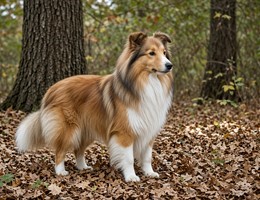
Other Names: Sheltie, Miniature Collie, Mini Lassie (slang), Shetland Collie (obsolete), Dwarf Scotch Shepherd (obsolete), Toonie Dog (obsolete)
Country of Origin: Scotland
Accreditation:
American Kennel Club (AKC): Herding
Canadian Kennel Club (CKC): Herding
United Kennel Club (UKC): Herding Dog
Australian National Kennel Council (ANKC): Working Dogs
The Kennel Club (KC): Pastoral
Kennel Union of Southern Africa (KUSA): Herding
National Kennel Club (NKC): Recognized
New Zealand Kennel Club (NZKC): Working Dogs
- Height:
- 13-16 inches
- Weight:
- 14-17 pounds
- Color(s):
- Black, blue merle, sable (from golden through mahogany), sable merle, marked with varying amounts of white, tan, or white and tan trim; or predominantly white, with a sable, black, blue merle or sable merle head, with or without tan trim
- Coat:
- Double; thick, weather-resistant; long, harsh, straight outer coat; soft, short, dense undercoat
- Description:
- The Shetland Sheepdog was intentionally bred small, and is ideally suited for the terrain of the Shetland Islands in Scotland. It was thought that the Sheltie herded the small sheep of the Shetland Islands, but many now feel that with their diminutive size they were used primarily to chase off scavengers, birds, pests, and wayward livestock which may have wandered into the crofter's gardens. Unlike many miniature breeds that resemble their larger counterparts, this breed was not developed simply by selectively breeding the Rough Collie for smaller and smaller sizes. Rather, he is a descendant of the Collie and while the Sheltie's exact origins are not known it is believed that other types such as the extinct Greenland Yakki dog, the Kings Charles Spaniel (not the Cavalier), the Pomeranian, and possibly the Border Collie were utilized in their development. Ironically, the Shetland Sheepdog is only rarely found in Shetland, having been replaced by the Border Collie.
- Temperament:
- Shelties are intelligent, lively, loving, playful, loyal, affectionate with their family, and willing to please and obey. They are naturally aloof with strangers, and some can be quite reserved. When raised with children, Shelties are very good with them, however their small size makes it easy for a child to accidentally injure them, so supervision is necessary. Caution should be exercised when considering an adult Sheltie for a family with young children, as they may not be compatible. The herding instinct is strong in many Shelties. They love to chase and herd things, including squirrels, ducks, and children. The average Sheltie is an excellent watch dog, giving alarm barks when a person is at the door, or a car is in the driveway. With sufficient exercise, Shelties can be as happy in an apartment in a city, as in a house in the country.
- Training:
- Shelties are intelligent, and highly trainable. They do best with a sensitive, yet firm, owner. Early socialization with children helps the Sheltie to be very good with children. It is easiest to teach the Sheltie to tolerate, or even enjoy, grooming, if he is shown that it is a pleasurable experience from a young age. Most Shelties learn to love the attention that grooming provides, if the routine is started when he is still young.
- Care & Grooming:
- Care should be taken when using gasoline powered yard care equipment in the presence of a Sheltie, giving particular attention during the starting process of weed-eaters (lawn trimmers) and chainsaws. The strong herding instinct quickly comes into play, but may subside once the Sheltie determines that his job has been done. Neglecting a Sheltie's need for exercise and intellectual stimulation can result in undesirable behaviors, including excessive barking, phobias, and nervousness. Shelties prefer exercise that engages him with his owner. The Sheltie is an intelligent herder, and likes to be kept busy. He loves to run in wide, open spaces. The space should be safe, and they should not get too far away. Shelties also excel at flyball, tracking, and herding, and participating in such sport will satisfy a Sheltie's need for mental and physical exercise. The Sheltie is usually a clean dog, and should only need to be brushed once or twice a week using an undercoat rake, which removes the dead and loose hair. . It is helpful to spray-mist him with water when brushing. Mats can be commonly found behind his ears, under his elbow on each front let, and in the fluffy fur on his hind legs. Regular brushing encourages undercoat growth, distributes healthful oils produced by the skin, and prevents sores known as "hotspots" which can occur when dead undercoat is allowed to accumulate close to the skin. Toenails and the hair between the pads need to be trimmed every couple of weeks to ensure traction, and to prevent mud and snow from balling up on his feet.
- Shedding:
- Seasonal; the long double coat blows a heavy undercoat twice a year.
- Health:
- Shetland Sheepdogs may inherit collie eye anomaly, the MDR1 drug-sensitivity mutation, and dermatomyositis in some lines. Tell your veterinarian about MDR1 before certain medications.
- Lifespan:
- 12–14 years
- Litter Size:
- 4–6 puppies
Crosses that include the Shetland Sheepdog
These hybrid pages list this breed as a parent. Open a name to see the other contributing breed.
Creature.com Copyright © 2015 - 2026 All Rights Reserved
Creature.com accepts no responsibility for the accuracy of the advertisements placed on the Creature.com website or for the contents of any website to which a hypertext link from Creature.com links. The Seller Ads and links to products and/or services are provided as a service, and Creature.com gives no warranties, expressed or implied, about the information and/or policies of the Seller Ads or the linked-to webites, or of the information shown.
Creature.com is the sole owner of the services and of all information provided by and posted to the Creature.com website. The use, reproduction, or storing of content for any purpose other than to contact a Seller, purchase a product or service, or compare prices is prohibited. You cannot use the information provided by Creature.com to recreate a directory, rebrand the informaton or redistribute the information in any way. Information provided by Creature.com is for individual, non-commercial use only. All information, processes and content contained within and that make up the services are the sole property of Creature.com. You may not reproduce, duplicate or redistribute any information provided by Creature.com for profit or personal gain of any kind. You may not frame any content or pages contained within the Creature.com website unless expressly granted permission by Creature.com.