

Siberian Husky
Other Names: Siberian, Sibe, Husky, Huskies, Chukcha, Chuksha, Keshia, Sibirsky Haski
Country of Origin: Russia (Siberia)
Accreditation:
American Kennel Club (AKC): Working
Canadian Kennel Club (CKC): Working
United Kennel Club (UKC): Northern Breed
Australian National Kennel Council (ANKC): Utility
The Kennel Club (KC): Working Dogs
Kennel Union of Southern Africa (KUSA): Working Dogs
National Kennel Club (NKC): Recognized
New Zealand Kennel Club (NZKC): Utility
- Height:
- Male: 21-23½ inches; Female: 20-22 inches
- Weight:
- Male: 45-60 pounds; Female: 35-50 pounds
- Color(s):
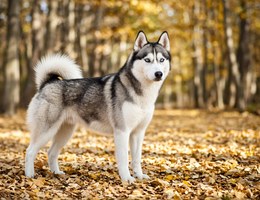
- All colors from black to white; the most common colors are black and white, gray and white, copper-red and white, and pure white, though many individuals have blondish, or piebald spotting
- Coat:
- Thick double coat, woolly dense undercoat and longer soft outer coat
- Description:
- The Siberian Husky, a working dog breed, is an active, energetic and resilient breed whose ancestors came from the extremely cold and harsh environment of the Siberian Arctic and were bred by the Chukchi of Northeastern Asia. The Siberian Husky was imported into Alaska during the Nome Gold Rush, and spread from there into the United States and Canada, initially as a sled dog. It rapidly acquired the status of a family pet and a show-dog. The Siberian Husky’s coat protects the dogs effectively against harsh Arctic winters, and also reflects the heat in the summer. Huskies are able to withstand temperatures as low as -58 degrees Fahrenheit.
- Temperament:
- Siberian Huskies are well-suited as companions and sled dogs, but they are unsuitable as guard dogs. Huskies demonstrate a strong sense of gentleness and devotion. However, Siberian Huskies are a very stubborn and dominant breed of dog. Huskies are known to howl, sing and talk, rather than bark.
- Training:
- A fifteen-minute daily obedience training class will serve well for Siberian Huskies. Siberians need consistent training, and do well with a "nothing in life is free" training program. Huskies are extremely intelligent, and after learning a new skill, will often decide when to show off this skill when asked to perform it.
- Care & Grooming:
- As a working breed, Siberian Huskies are a high-energy dog requiring lots of exercise.
- Shedding:
- Seasonal and heavy; the northern coat blows once or twice a year.
- Health:
- Siberian Huskies may develop hip dysplasia, progressive retinal atrophy, cataracts, and zinc-responsive skin disease. They do poorly in prolonged heat without shade and water.
- Lifespan:
- 12–14 years
- Litter Size:
- 4–6 puppies
Crosses that include the Siberian Husky
These hybrid pages list this breed as a parent. Open a name to see the other contributing breed.
Creature.com Copyright © 2015 - 2026 All Rights Reserved
Creature.com accepts no responsibility for the accuracy of the advertisements placed on the Creature.com website or for the contents of any website to which a hypertext link from Creature.com links. The Seller Ads and links to products and/or services are provided as a service, and Creature.com gives no warranties, expressed or implied, about the information and/or policies of the Seller Ads or the linked-to webites, or of the information shown.
Creature.com is the sole owner of the services and of all information provided by and posted to the Creature.com website. The use, reproduction, or storing of content for any purpose other than to contact a Seller, purchase a product or service, or compare prices is prohibited. You cannot use the information provided by Creature.com to recreate a directory, rebrand the informaton or redistribute the information in any way. Information provided by Creature.com is for individual, non-commercial use only. All information, processes and content contained within and that make up the services are the sole property of Creature.com. You may not reproduce, duplicate or redistribute any information provided by Creature.com for profit or personal gain of any kind. You may not frame any content or pages contained within the Creature.com website unless expressly granted permission by Creature.com.